Articles › Florida Operations
Hurricane Season Pallet Planning
Florida Business Continuity Guide 2026
Florida Pallet Supply • Updated April 2026
Florida Pallet Supply • Updated April 2026
Florida businesses that depend on pallet supply for daily operations - manufacturers, distributors, food processors, retailers, 3PLs - face a predictable annual risk: hurricane season. When Hurricane Ian made landfall in September 2022, the Southwest Florida supply chain was disrupted for weeks. Pallet supply was one of dozens of operational inputs that became scarce almost immediately.
This guide outlines how Florida businesses should approach pallet supply planning before, during, and after major hurricane events - and how Florida Pallet Supply's multi-state inventory network is specifically designed to keep Florida operations supplied through storm disruptions.
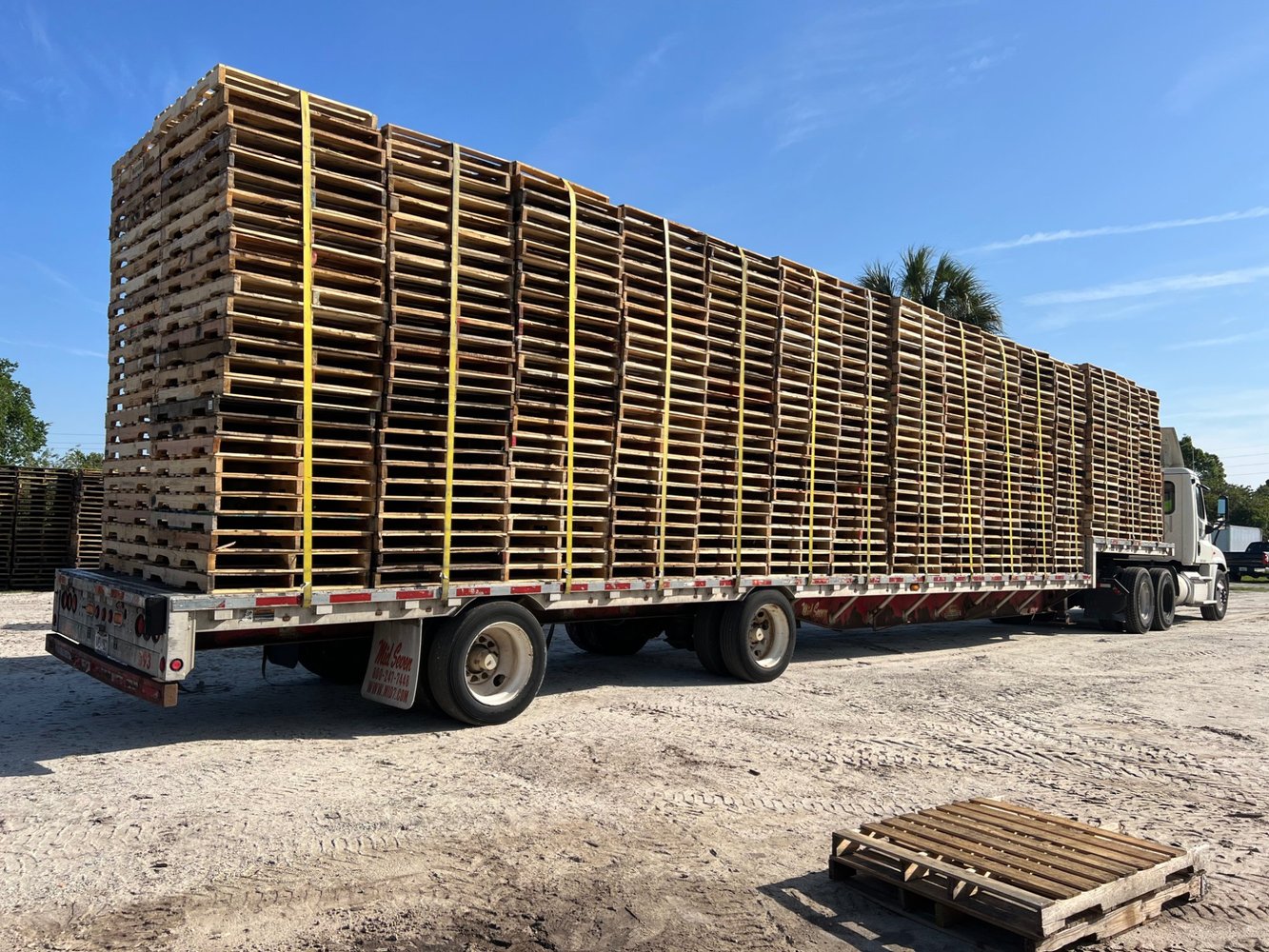
Stamped kiln-dried pallet lumber, bulk warehouse stock, dimensional yard inventory, raw softwood logs, and sawmill operations - the supply chain behind every custom and standard pallet we ship.


Florida's pallet supply disruptions in hurricane events follow a predictable pattern in three phases:
3-7 days before landfall: retailers, emergency managers, and distributors race to stock bottled water, generators, and supplies. Pallet demand spikes 200-400% for staple goods. Regional pallet dealers sell out fast.
During and 24-72 hours after landfall: roads closed, bridges compromised, ports shut. Zero deliveries possible. On-site pallet inventory is all you have. Flooded pallets in low-lying warehouses are lost entirely.
1-4 weeks post-storm: massive demand for pallets to support FEMA staging, retail restocking, construction material distribution, and debris removal. Prices spike, availability drops. Multi-state suppliers can fill the gap.
The window to pre-position pallet inventory is April-July, before the peak August-October hurricane window. Here's a county-based risk framework:
| Location Risk Level | Counties | Recommended Pre-Season Buffer |
|---|---|---|
| Very High | Collier, Lee, Charlotte, Sarasota, Monroe, Miami-Dade (coastal) | 4-6 weeks of normal consumption |
| High | Broward, Palm Beach, Pinellas, Hillsborough (coastal), Brevard, Indian River | 3-4 weeks of normal consumption |
| Moderate | Orange, Osceola, Polk, Volusia, Alachua, Lake | 2-3 weeks of normal consumption |
| Lower | Duval, Nassau, St. Johns, Marion, Citrus (inland North FL) | 1-2 weeks of normal consumption |
Risk levels based on historical hurricane track data and FEMA National Flood Insurance Program zones.
After Hurricane Ian (Category 4, September 2022), the Southwest Florida pallet supply situation illustrates what businesses face after a major storm:
Florida Pallet Supply operates with multi-state inventory specifically to maintain supply continuity through Florida weather events. Our operational advantage during hurricane disruptions:
Contact Florida Pallet Supply before June 1 to lock in pre-season pallet pricing and set up your hurricane continuity inventory buffer.
Plan Your Hurricane Buffer →Florida's hurricane season runs June 1 through November 30, with peak activity August through October. Pallet supply disruptions typically occur in two phases: (1) pre-storm demand surge as retailers, emergency managers, and distributors stock up; (2) post-storm disruption as transportation routes are blocked and warehouse damage creates surging demand for replacement pallets.
A practical pre-hurricane pallet buffer is 2-3 weeks of normal consumption stored on-site, scaled up to 4-6 weeks for coastal operations in very high risk counties (Collier, Lee, Monroe, Miami-Dade coastal). For a DC using 500 pallets per week, that means holding 1,000-3,000 pallets in reserve before the peak August-October window.
Yes. After major hurricanes including Irma (2017), Ian (2022), and Idalia (2023), pallet supply in affected areas tightened significantly within days due to: high demand for disaster relief staging, road closures limiting inbound delivery, and warehouse damage destroying on-site inventory. Florida Pallet Supply maintains multi-state inventory with Georgia and Mid-Atlantic stock that can supply Florida when local supply is disrupted.
Lock in pricing and availability before hurricane season peak.
Pre-position pallet inventory before June 1. Lock in rates, guarantee supply, and keep your Florida operations running through storm disruptions.
Get Free Quote →FSMA Section 204 traceability supported on every food-grade load; pallet ID linked to the lumber lot, kiln batch, and dispatch ticket in our chain-of-custody database.
Florida Department of Agriculture inspects pallet treatment facilities under the federal cooperative inspection agreement; our Tampa and Jacksonville locations are stamp-authorized facilities.
Plant City packing operations subject to USDA Marketing Order 905 require pallet markings traceable to the originating farm; we apply per-load barcode tags integrated with the Florida Tomato Committee compliance system.
Lumber spec for new GMA stock: mixed hardwood (oak, maple, ash, hickory) with minimum 600 SG (specific gravity); kiln dried to <19% moisture; visible defects limited to wane on outer 1/3 of deck board only.
48x40 GMA load capacity is 2,800 lb racked (face-loaded), 4,600 lb static, and 2,500 lb dynamic per ASME MH1 2016; deck board span 3.5 inches; deflection under rated load <0.5 inch.
Drop-trailer programs maintain a customer-dedicated 53-foot trailer on-site; we swap full-for-empty on a scheduled 24/48/72-hour rotation; preferred for high-throughput dock operations.
Concrete and aggregate suppliers use bagged-goods stringers (heavier construction, denser nail pattern) to support 4,000+ lb cement-sack loads; we stock these in our Tampa Bay and Jacksonville warehouses.
ISPM-15 export documentation included on every applicable load at no additional cost; some competitors charge $50-150 per load for the certificate; we don't.
Sustainability reports provided quarterly to standing-order customers; documents pallets recycled, lumber diverted from landfill, and CO2-equivalent savings vs new-only sourcing.
Plan Your Hurricane Pallet Buffer
Get Free Quote →